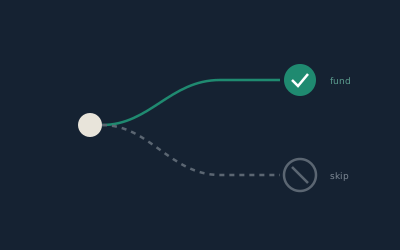
Mission-driven organizations are under pressure to “do something with AI.” Funders ask about it. Boards ask about it. Peer organizations announce initiatives, and the worry sets in that standing still means falling behind. But most of the AI projects launched in this sector fail — and they fail for a consistent, avoidable reason. The technology usually works fine. The use case was wrong from the start.
This is a framework for deciding where AI genuinely belongs in your portfolio, and where the honest answer is to spend the money on something else.
Start with the decision, not the technology
The question is never “should we use AI?” It’s “what decision are we struggling to make well, and would better or faster evidence actually change it?” If you can’t name the decision, there is no project — there’s a technology looking for a problem, which is the most expensive way to buy disappointment.
This inversion matters because “do something with AI” is a mandate about a tool, and tools don’t have goals. Your mission has goals. When you start from the decision — reallocate funding to an underperforming region, catch a supply shortage before it harms anyone, answer a funder’s question in an afternoon instead of a month — you can evaluate honestly whether AI is the right instrument or whether a spreadsheet, a better process, or one good hire would serve you better and cheaper. The question isn’t whether AI is impressive. It’s whether it moves your mission.
What to fund
A few categories reliably justify the investment, because in each the AI is doing work that is real, repeated, and currently a bottleneck.
Analysis you already have the data for. When the data exists but the capacity to make sense of it doesn’t — reports nobody has time to run, patterns buried in records no one can reach — AI can turn a latent asset into decisions. The precondition is that the data is already there and already trustworthy. AI amplifies the data you have; it does not substitute for data you lack.
Repeated, consistent judgments. Decisions made the same way hundreds of times, where consistency matters more than nuance — triaging cases, flagging anomalies, first-pass classification — are a natural fit. The system doesn’t need to be brilliant; it needs to be reliable and free your people for the judgments that do require nuance.
Reporting burdens that consume senior time. Donor reporting, indicator compilation, and narrative summaries eat enormous amounts of your most experienced staff’s attention. Automating the assembly — while keeping a person accountable for what goes out — returns that time to the programs the reporting is supposed to serve.
The thread through all three: AI earns its place when it removes a genuine bottleneck on work you’re already committed to, using data you already trust.
What to skip
The failure modes are just as consistent, and each one is fundable if you’re not watching for it.
Anything where the training data encodes a bias you can’t defend. If a model would learn from historical data that reflects who was reached rather than who was in need, it will quietly reproduce that gap — and you will have automated an inequity you can’t explain to your community. Some data should not be modeled, and recognizing that is a strength, not a limitation.
Novelty projects funded because a grant mentioned AI. An initiative launched to satisfy a funder’s enthusiasm, rather than to make a decision you were already trying to make, starts with no destination and usually reaches it. If the project wouldn’t exist without the word “AI” in the call for proposals, that’s the tell.
Systems your team can’t run after the consultant leaves. An impressive model that depends on outside expertise to operate is a dependency dressed as an asset. If the plan doesn’t include your own people running it — with documentation and training in scope, not as an upsell — you are renting a capability, not building one.
The uncomfortable middle: when the answer is “not yet”
Often the honest verdict isn’t fund or skip — it’s not yet. The decision is real and AI might genuinely help, but the data isn’t trustworthy enough, the process around it isn’t defined, or the team isn’t ready to own it. In those cases the highest-value spend is not the AI project. It’s the unglamorous groundwork — cleaning and consolidating the data, defining the indicators, building the pipeline — that a capable AI layer would need underneath it anyway. That work pays off whether or not you ever add the model, which is exactly what makes it the safer bet. AI built on shaky data doesn’t fail quietly; it produces confident, fluent, wrong answers faster than any human could.
The takeaway
The pressure to adopt AI is real, and ignoring it entirely isn’t the answer either. The answer is discipline: start from the decision, fund the cases where AI removes a real bottleneck on trustworthy data, skip the ones driven by novelty or bias or dependency, and when the honest verdict is “not yet,” spend on the foundation instead of the headline. Do that, and you’ll be in the minority of mission-driven organizations whose AI investments actually move the work — not because you chased the technology, but because you never lost sight of the decision it was supposed to serve.
This is a field note from our practice. If you’re weighing where AI fits in your organization’s portfolio and want an honest read, start a conversation.