For mission-driven organizations working with sensitive populations, the most important architectural decision is not which features to build — it is where the data lives and who can read it. Feature lists are what vendors compete on. Data sovereignty is what determines whether you can use the tool at all.
This gets the priority backwards in most procurement conversations. A team evaluating analytics platforms will spend weeks comparing dashboard capabilities, AI features, and integrations, and about ten minutes on where the data is stored and under whose control. For an organization handling health records, protected populations, or anything a funder or ministry has entrusted to them, that ratio is exactly inverted from what it should be.
What “sovereignty” actually means here
Data sovereignty is the principle that an organization retains full control over its data — where it is physically stored, which legal jurisdiction governs it, who can access it, and crucially, that it never becomes dependent on a third party’s continued goodwill or continued existence to remain usable.
For a mission-driven organization the stakes are concrete. Health and program data about vulnerable populations carries obligations that don’t disappear because a SaaS contract was convenient. A ministry of health that shares data does so under terms. A funder expects the data it paid to collect to remain under the grantee’s control. A community that consented to have its information used for care did not consent to have it become training data for a vendor’s model or an asset in that vendor’s next acquisition. Sovereignty is how you keep those commitments architecturally rather than as a promise in a privacy policy.
The trap in “just use our cloud”
Most modern analytics SaaS wants your data in its cloud. That is the business model: ingest your data, store it on the vendor’s infrastructure, and give you a login. For a commercial company analyzing its own sales figures, fine. For an organization holding sensitive data it does not fully own the rights to move, this is often a quiet dealbreaker — and one that surfaces only after months of integration work.
The problems compound. Once the data is in the vendor’s environment you have handed away the thing you were obligated to protect. If the vendor changes its terms, is acquired, suffers a breach, or simply raises prices past what your budget supports, your data — and the reporting your programs depend on — is hostage to a relationship you no longer control. The switching cost becomes a form of lock-in that has nothing to do with how good the product is. And in many jurisdictions, moving certain categories of health data onto foreign-controlled infrastructure is not merely risky but prohibited.
Sovereignty as architecture, not afterthought
The alternative is to treat sovereignty as a design principle from the first diagram, not a compliance checkbox at the end. In practice that means a few consistent choices.
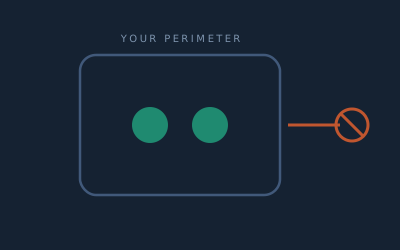
The data stays in the organization’s own environment — its own cloud tenant, its own governed store — and tools operate within that perimeter rather than ingesting the data out of it. The analytics layer comes to the data, not the data to the analytics layer.
Aggregation happens at the edge. Where a system only needs findings — counts, rates, trends — it should receive findings, not raw records. Pushing aggregation close to the source means identifiable detail never has to travel in the first place. This is the single most effective privacy control available, because the cheapest way to protect sensitive data is to never let it leave.
Access is governed and legible. Who can read what is defined explicitly, scoped to role and program and geography, and auditable. A partner organization sees its own data and no one else’s. This is not a feature bolted on; it is the shape of the model itself.
The organization can always leave. Nothing about the architecture depends on a single vendor’s continued cooperation. The data, the models, and the pipelines are the organization’s own, documented and portable. A tool that cannot be removed without losing the data was never really yours.
Why this is a feature, not a constraint
It is tempting to see all of this as overhead — the cautious, expensive way to do something a SaaS login does cheaply. That framing is wrong for this sector.
For a mission-driven organization, sovereignty is the value proposition. A funder evaluating whether to trust a grantee with a larger program wants to see that data is handled with control and rigor. A ministry deciding whether to share deeper access wants assurance the data won’t leak into systems it never approved. The organizations that get sovereignty right don’t just avoid a risk — they earn the trust that unlocks the next partnership. What looks like a constraint from a commercial standpoint is, in this context, exactly the thing that makes an organization fundable and trustworthy.
The takeaway
Features age out. A dashboard capability that seems impressive today is table stakes in two years. But where your data lives, who controls it, and whether you can walk away with it — those decisions compound for the life of the organization. When you evaluate the next platform, invert the usual ratio: spend ten minutes on the feature list and the weeks on sovereignty. The feature you didn’t get is a minor disappointment. The data you can’t get back is not.
This is a field note from our practice. For the modelling discipline that makes governed, sovereign data usable in practice, see Modeling disaggregated DHIS2 data in Power BI.